


The ongoing controversy in Abonnema Kingdom, Akuku-Toru Local Government Area of Rivers State, has taken a fresh turn as a dispute over traditional titles and royal prefixes introduces a new dimension to the already sensitive legal battle.
The latest development stems from a motion reportedly filed by the Amayanabo of Abonnema, HRM King (Dr.) Disrael Gbobo Bob-Manuel II, seeking legal clarification on the use of royal honorifics within the kingdom.

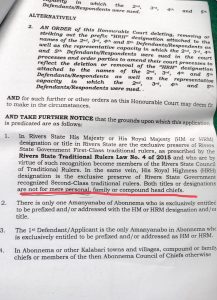
In the filing, the monarch is said to have asserted that only the Amayanabo should be addressed with the royal prefixes HRM/HRH, while members of the traditional council should be referred to simply as Chiefs.
Although the matter appears on the surface to concern protocol, observers say it has raised broader questions within the context of Appeal No: CCA/PH/37/2025, the legal dispute currently before the court.
A member of the Abonnema Council of Chiefs, who spoke on condition of anonymity, said the development introduces a completely new dimension to the issues already under judicial consideration.
According to the source, the central question now being raised in many circles is how the issue of titles and prefixes relates to the substantive matters before the court.
Legal observers note that the core dispute in the case revolves around questions of process, legitimacy and historical claims. They warn that introducing a title-related clarification at this stage risks diverting attention from the main legal issues and could complicate an already delicate cultural and institutional matter.
The motion has also reportedly stirred reactions within the traditional council. Prominent Kalabari figures, including Chief Dumo Lulu-Briggs and Chief Tammy Wenike Danagogo, who are often publicly addressed with elevated honorifics, were in the referenced motion categorized under the broader designation of “Chiefs.”
Within Kalabari tradition, titles and honorifics carry deep cultural and symbolic significance, often reflecting lineage, historical contributions and standing within the traditional institution.
Sources within the kingdom suggest that this aspect of the filing may have triggered dissatisfaction among some members of the council of chiefs. At least one chief, speaking anonymously, is alleged to have released documents aimed at shedding more light on the matter.
While the authenticity and implications of the documents remain subject to scrutiny, their circulation has fueled speculation that internal concerns within the traditional council may be spilling into the public domain.
The development has also reignited debate within Kalabari circles over whether the move represents an attempt to redefine traditional hierarchy or simply clarify royal protocol.
Some commentators argue that the strength of Kalabari traditional institutions has historically rested on mutual respect between the throne and the council of chiefs, with clearly understood roles and shared dignity.
Others, however, caution against reading too much into the legal filing, noting that courts are not arbiters of cultural prestige and that such matters may be better addressed within established traditional frameworks.
Meanwhile, a group known as Kalabari Advocacy for Justice has condemned what it described as the petitioning of prominent Abonnema and Kalabari sons with what it called fictitious and unfounded claims while the matter remains before the court.
The group warned that such actions could escalate tensions and potentially undermine peace in the kingdom. While stressing that it is not taking sides in the dispute, the group urged all parties involved to exercise restraint and allow the court to determine the issues in contention.
Observers say the development underscores the growing urgency of earlier calls by stakeholders for transparency, due process and unity within the kingdom.
Beyond the personalities involved, many believe the central challenge remains how Abonnema Kingdom will manage internal disagreements while preserving its cultural heritage and institutional credibility.
As events continue to unfold, residents of Kalabari land and observers across Rivers State are watching closely—not only for the legal outcome of the case, but also for signals on how the historic kingdom navigates authority, dissent and unity at a critical moment.
Copyright © EaglesWatchOnline 2023 All rights reserved.
This material, and other digital content on this website, may not be reproduced, published, broadcast, rewritten or redistributed in whole or in part without written permission from EaglesWatchOnline.
