
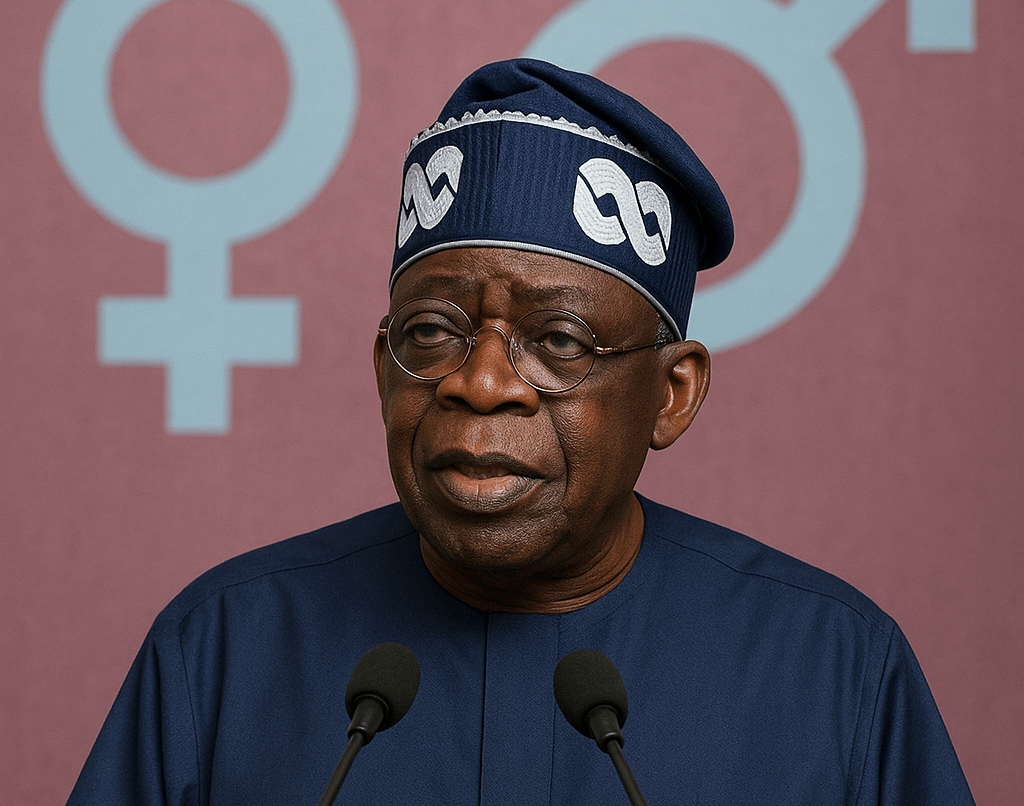

The United States Federal Bureau of Investigation (FBI) has told a federal court that releasing portions of records relating to investigations involving Nigerian President Bola Ahmed Tinubu could expose individuals to retaliation and potentially endanger their lives or physical safety.
The disclosure is contained in filings before the United States District Court for the District of Columbia in Washington, where the FBI is defending its decision to withhold portions of records sought under the Freedom of Information Act (FOIA).
The records are being sought by American transparency activist Aaron Greenspan, who filed a FOIA lawsuit against several United States government agencies over historical investigative records concerning Tinubu.
The case, Greenspan v. Executive Office for U.S. Attorneys et al., Civil Action No. 1:23-cv-01816 (BAH), has been before Judge Beryl A. Howell and has become the latest chapter in a years-long legal battle over access to US government records relating to Tinubu and investigations dating back to the early 1990s.
FBI seeks to justify withholding records privately
The FBI has invoked several exemptions under the US Freedom of Information Act, including Exemptions 6, 7(C), 7(D), 7(E) and 7(F), in defending its withholding and redaction of information.
Of particular significance is Exemption 7(F), which concerns information whose disclosure could reasonably be expected to endanger the life or physical safety of an individual.
According to the FBI, some of the disputed material could reveal law-enforcement investigative techniques and procedures, while disclosure of certain names or identifying information could expose people connected with investigations to retaliation.
The bureau has argued that it cannot publicly disclose the complete basis for relying on some of the exemptions because doing so could itself reveal sensitive investigative information that the exemptions are intended to protect.
It consequently asked Judge Howell for permission to submit additional explanations and supporting materials ex parte, in camera and under seal — meaning that the judge would examine them privately rather than placing the sensitive material on the public court record.
The FBI’s August 20 filing specifically said that disclosure of some of the withheld information could “reasonably be expected to endanger the life or physical safety of any individual.” The filing, however, does not publicly identify the individual or individuals whose safety it believes could be endangered.
That distinction is important because claims circulating that the FBI explicitly said President Tinubu or its agents would be assassinated go beyond what the publicly available filing itself establishes.
What Greenspan is seeking
The legal dispute stems from multiple FOIA requests submitted by Greenspan to US federal agencies.
Among the requests before the court are two directed to the FBI.
One request, numbered 1588244-000, sought the entire FBI file relating to Bola Ahmed Tinubu.
A second request, numbered 1593615-000, sought FBI Form 302 interview records involving Tinubu in connection with FBI Case No. 245-IP-71386-UUUUUU, covering the period between 1992 and 1993.
Greenspan also sought records from other US agencies, including the Drug Enforcement Administration (DEA), Central Intelligence Agency (CIA), Internal Revenue Service (IRS), the Department of State and US immigration authorities.
The broader requests relate to historical investigations into an alleged Chicago-based heroin trafficking and money-laundering operation in the early 1990s.
According to court records, the investigations involved several individuals, including Tinubu, Lee Andrew Edwards, Mueez Abegboyega Akande and Abiodun Agbele.
FBI initially refused to confirm existence of records
The FBI’s position in the case dates back to its initial responses to Greenspan’s requests.
Rather than confirming or denying whether records existed, the bureau initially issued what is known as a “Glomar response”, a legal position under FOIA that allows an agency to refuse to confirm or deny the existence of responsive records where doing so could itself disclose protected information.
The FBI relied at the time on privacy-related exemptions, arguing that even acknowledging the existence of records concerning a third party could constitute an unwarranted invasion of privacy.
Greenspan challenged the agency’s position in court, leading to years of litigation over the scope of the records that should be searched, released, redacted or withheld.
In April 2025, Judge Howell ruled on portions of the dispute and directed the agencies to search for and produce non-exempt, reasonably segregable portions of responsive records. The continuing disagreement has centred on what information can legally be withheld or redacted.
Tinubu intervenes in the case
President Tinubu has also become directly involved in the litigation.
Court filings show that Tinubu intervened in the case and asked the court to uphold privacy protections and allow the FBI and DEA to maintain certain redactions and withholdings.
In a filing in September 2025, Tinubu argued that information identifying him could properly be withheld under FOIA privacy exemptions.
More recently, reports said Tinubu asked the court to reject Greenspan’s request for broader disclosure of the records, maintaining that the documents were protected by privacy provisions under US law.
The $460,000 forfeiture controversy
The renewed interest in the FBI records is also linked to a 1993 civil forfeiture case in the United States involving approximately $460,000 in a bank account bearing Tinubu’s name.
A US District Court in Illinois ordered the forfeiture of the funds after a civil proceeding involving accounts connected to Tinubu. The court order stated that the funds represented proceeds of narcotics trafficking or were involved in financial transactions violating US law.
The issue resurfaced prominently during Nigeria’s 2023 presidential election litigation.
Tinubu’s then-party, the All Progressives Congress (APC), argued before the Presidential Election Petition Court that the forfeiture was a civil forfeiture proceeding and did not amount to a criminal conviction or fine imposed personally on Tinubu.
The Presidential Election Petition Tribunal subsequently held that the petitioners had failed to establish that Tinubu had been criminally convicted, sentenced or fined in the United States over the forfeiture. The tribunal described the matter as a civil forfeiture proceeding.
Tinubu’s supporters have also disputed interpretations linking him personally to drug trafficking, with then-APC spokesman Festus Keyamo arguing that the forfeiture concerned funds in accounts rather than a criminal conviction against Tinubu.
FBI records now before Judge Howell
The dispute took another significant turn in August 2026 after Judge Howell directed the FBI to explain its continued withholding of the records.
The bureau subsequently sought permission to make its detailed explanation privately and, according to reports, submitted the disputed materials to the court under seal on August 28 for the judge’s review.
The submission was made ex parte and in camera, meaning that the judge, rather than the public or the parties generally, would examine the sensitive material.
The FBI’s latest position therefore does not amount to a public release of the contents of the records, nor does its invocation of the safety exemption establish that Tinubu committed a criminal offence.
Rather, the immediate legal question before Judge Howell is whether the FBI has adequately demonstrated that portions of the records are protected from disclosure under US FOIA law.
What happens next?
The court’s decision could determine whether additional portions of the long-sought records are released, remain redacted or continue to be withheld.
For now, the most significant development is that the FBI has placed its detailed justification and the disputed materials before Judge Howell for private judicial review.
The contents of the sealed records have not been made public, meaning that claims about what the documents ultimately contain remain unverified unless and until the court orders their disclosure.
The case continues to attract attention in Nigeria because of its potential implications for longstanding questions surrounding Tinubu’s activities in the United States in the early 1990s and the circumstances surrounding the 1993 forfeiture of $460,000.
However, the current court proceedings are fundamentally a FOIA disclosure dispute, and the FBI’s latest filing should not, by itself, be interpreted as a finding of criminal liability against the Nigerian president.
Copyright © EaglesWatchOnline 2023 All rights reserved.
This material, and other digital content on this website, may not be reproduced, published, broadcast, rewritten or redistributed in whole or in part without written permission from EaglesWatchOnline.
